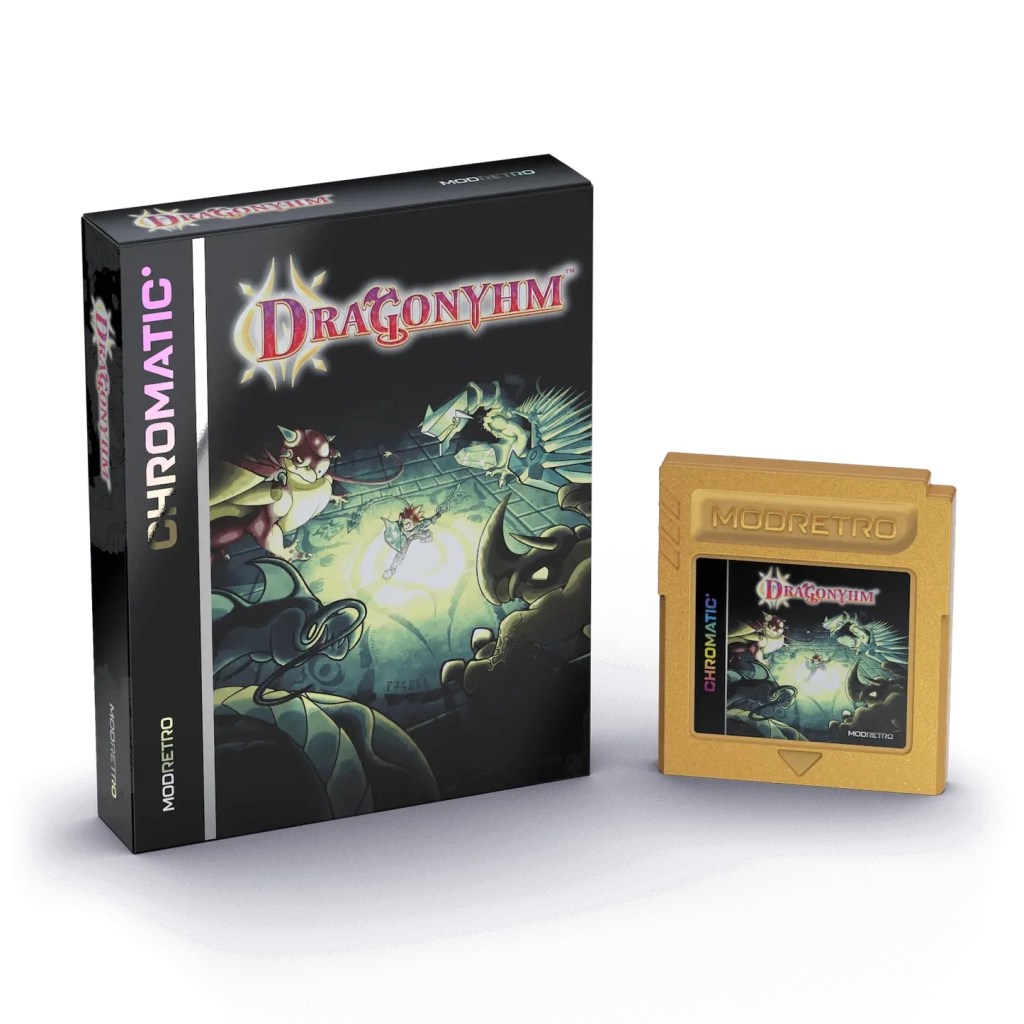


In an era where RPGs sprawl across massive open worlds with cinematic cutscenes and endless quest markers, Dragonyhm makes a confident counterstatement. Developed by Spacebot Interactive and published by ModRetro, this is a full-scale fantasy adventure deliberately built for 8-bit hardware.
Released as a physical cartridge for the ModRetro Chromatic and fully compatible with the original Game Boy Color, Dragonyhm doesn’t just imitate the past, it authentically inhabits it. The presentation, pacing, and mechanical discipline feel right at home alongside handheld classics like The Legend of Zelda: Link’s Awakening and Final Fantasy Adventure.
But what elevates Dragonyhm is that it’s more than a tribute. It’s ambitious.
A Classic Setup, Executed with Confidence
The story begins with a tapestry recounting an ancient dragon war; one dragon slain, another sealed away. Kris, the young protagonist, awakens to discover his father, a legendary dragon-slayer, has vanished. The quest to find him quickly expands into something larger.
The narrative doesn’t rely on excessive exposition. Instead, it trusts the player to absorb its world through exploration, dungeon progression, and environmental cues. It’s restrained storytelling that respects the hardware and the audience.
Combat That Rewards Understanding
The early hours demand patience. The first dungeon is challenging if approached under-leveled, and yes, some grinding is required. But this isn’t artificial padding, it’s foundational RPG design. Once properly leveled, the systems reveal their depth.
Combat features:
Behavior-influenced stat growth (strength, magic, agility)
Logical elemental weaknesses (ice-based Eisgeists fall to fire)
A flee system tied directly to agility progression
Tactical magic and attack combinations
Agility progression, reminiscent of classic late-’90s RPG systems, meaningfully impacts survivability. When maxed, fleeing becomes guaranteed. That kind of tangible mechanical payoff makes every level-up feel earned.
The battle system is not simplistic, nor is it derivative. It rewards experimentation and punishes autopilot play.
Scarcity That Sharpens Strategy
Healing items are limited early on, and that scarcity matters. Potion must be purchased with Giliya, the Archendi currency, or funded through fishing and careful grinding. As stats rise, dependence on consumables drops naturally.
The economy and difficulty curve are tightly interwoven.
Preparation matters.
Resource management matters.
Victory feels intentional.
Remarkable Scope on 8-Bit Hardware
What’s most impressive is how much is packed into this cartridge:
9 substantial main dungeons
Hidden and secret areas throughout the world
A fully realized stat-driven battle and leveling system
Overworld enemies with learnable avoidance patterns
On original Game Boy Color hardware, this level of design density feels almost defiant.
Why Dragonyhm Stands Out
Dragonyhm succeeds because it understands its medium. It doesn’t dilute mechanics for modern convenience, nor does it hide behind nostalgia. It commits to the structure and discipline of classic handheld RPGs and executes at a high level.
This is a game that:
Trusts players to learn
Rewards strategic thinking
Delivers meaningful progression
Feels genuinely at home on retro hardware
Pass or Play?
Play
For gamers who value traditional RPG design—and for those curious what a modern developer can achieve within strict 8-bit constraints—Dragonyhm isn’t just impressive… it’s exemplary.
 Pocket Sized Adventure: A Game Boy Blog
Leave a comment